Guide ·
How to Size an Industrial Heater
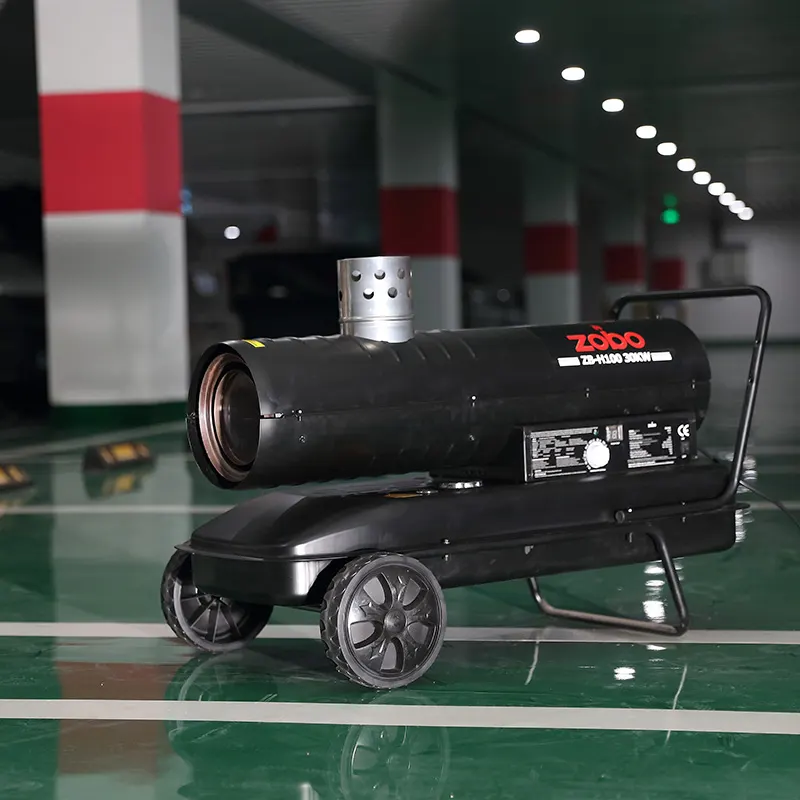
How to size an industrial heater starts with your building and operating requirements. Compare heat output, heating volume or area, and rating conditions for the proposed models. Give those specifications and your site requirements to the person responsible for the sizing review.
Gather what the sizing review actually needs
What space is being considered, and which dimensions has your reviewer asked for? Working temperatures, operating schedule, door openings, the building’s construction — all of it belongs in the inquiry, because all of it moves the answer. Ask who will calculate the heating requirement and what documentation they want in front of them. Record their reply next to the proposed model code and the manual you requested. A sizing exercise that starts with the building ends with a heater that fits it.
Guard the unit on every figure you copy
The models in this table rate heating volume in m³. Elsewhere in the catalog you will find heating area in sq ft or m². Those units are not interchangeable, and a comparison that mixes them is worse than no comparison. Copy each value with its unit and its qualifier, and ask what conditions accompany the rating before setting it against a site requirement. If a figure must be converted, that is a question for the supplier, answered in writing — not a spreadsheet trick.
One unit, or several? Say which, and why
Is the request for a single heater or a row of named units? What installation plan goes with that quantity? Ask your reviewer to test the arrangement against the model documentation, and keep output, airflow and coverage as separate lines in the worksheet while they do it. What you want from us at this stage is the reasoning behind a proposed selection, documented per model — sizing starts from each model’s rated conditions, not from adding ratings together until the building looks covered.
Model specification comparison
Compare heat output, fuel, power supply and other specifications for each model. Keep units and qualifiers attached to every value. Ask us for further specifications by model code, and record output settings, consumption, coverage and supply separately.
| Model | Heat output | Fuel | Power supply | Fuel tank / cylinder | Fuel consumption | Heating volume / area | Airflow | Ignition / control | Product size | Net / gross weight |
|---|---|---|---|---|---|---|---|---|---|---|
| ZB-H100 | 30 kW (100,000 BTU) | Kerosene, diesel | 110V / 60Hz, 220V / 50Hz | 50 L | 2.9 L/h | 480 m³ | On request | Continuous spark ignition; thermostat | 1100 × 550 × 600 mm | 30.5 / 33.6 kg |
| ZB-K175 | 51 kW (175,000 BTU) | Kerosene, diesel | 110V / 60Hz, 220V / 50Hz | 50 L | 4.8 L/h | 1,020 m³ | On request | Continuous spark ignition; thermostat | 1060 × 540 × 575 mm | 22.3 / 25.8 kg |
| PLUS K180 | 51 kW | Kerosene, diesel | 110V / 60Hz, 220V / 50Hz | 50 L | 4.8 L/h | 1,060 m³ | On request | Continuous spark ignition; thermostat | 1130 × 560 × 735 mm | 25.6 / 28 kg |
| ZB-K350 | 100 kW | Kerosene, diesel | 220V / 50Hz | 70 L | 9.8 L/h | 2,000 m³ | On request | Continuous spark ignition; thermostat | 1310 × 500 × 750 mm | 52 / 56.5 kg |
| ZB-EF2 | 25 W / 1,000 W / 2,000 W (three settings) | On request | 220V / 50Hz | On request | On request | 40 m³ | 120 m³/h | On request | 220 × 200 × 320 mm | 3.5 / 4.0 kg |
| ZB-EC15 | 85 W / 7,000 W / 15 kW (three settings) | On request | 380V / 50Hz | On request | On request | 300 m³ | 1,292 m³/h | On request | 645 × 484 × 697 mm | 20.1 / 21.5 kg |
Questions for the shortlisted models
ZB-H100
This model runs on kerosene and diesel. Specify your chosen fuel and request its grade and filling instructions. If the quotation needs a running-time figure, ask for a documented one for this model and the conditions attached to it. Then let your reviewer work through the operating instructions before the price hardens into a decision.
ZB-K175
There are two voltage and frequency options, so name the version you want and ask for the connection instructions that belong to it. The model has continuous spark ignition with a thermostat; ask which manual pages explain those controls, and send any control questions you cannot close with the model code attached. A question labelled ZB-K175 gets answered for ZB-K175.
PLUS K180
Ask for the manual behind the ignition and thermostat entries, and which control instructions accompany the order. On shipping, be precise about whether you mean the unit or its packaging — then confirm which net and gross figures go on your receiving documents and what packaging detail needs confirming for this order. Similar outputs elsewhere in the range do not answer for this code.
ZB-K350
The heating entry is a volume, so ask what conditions it was rated under before it goes anywhere near a project. Your reviewer will want to say what site information travels with the model code — and the proposed application stays a question in that exchange, not a conclusion. Placement, ventilation and clearance instructions from the manual get checked before the selection is treated as final.
ZB-EF2
Airflow and noise both carry figures here, so ask what measurement conditions accompany them and which of those fields your purchasing review needs documented. The output settings stay in their own row. If the intended arrangement needs particular control or connection information, ask for it from the manual and include the exact model code in your request.
ZB-EC15
Read the heat row exactly as printed; it carries separate entries, and collapsing them into one setting would misquote the unit. Ask which entry your specification needs and request the control and supply instructions that explain it. Your electrical reviewer should say what they require before this version is written into a purchase specification.
Build the quotation worksheet
The worksheet for a sizing review has three layers: the printed model figures, the supplier’s answers, and your site description. Model code at the top of each column, rating unit copied with every value, and a column reserved for the conditions the supplier documents behind those ratings.
Heat rows go in whole — settings, units, qualifiers. Volume and area figures never convert silently; if a comparison needs a different unit, the supplier confirms it in writing. And no adding ratings together to reach a building: the sizing reasoning is requested, per model, with the manual behind it.
Buyer confirmation checklist
- Is the exact model code on every request for a missing field?
- Has the reviewer’s list of site dimensions and conditions been supplied?
- Is every rating copied with its original unit — m³, sq ft or m²?
- What conditions accompany each rating, in writing?
- Is the request for one unit or several, and is the arrangement documented?
- Are output, airflow and coverage kept as separate worksheet lines?
- Which manual pages support the proposed selection?
- Who signs off the sizing result before ordering?
Follow up with the relevant specifications and guides
Sizing work continues wherever the figures live. These routes lead back to model fields and sideways into related reviews — rating units attached to every number you carry.
Open Diesel Kerosene Heaters. What is still unanswered about the proposed unit? Add it to the worksheet and request the documentation with your quote.
Open Industrial Electric Heaters. What is still unanswered about the proposed unit? Add it to the worksheet and request the documentation with your quote.
Open Warehouse Heater Guide for Commercial Spaces. What is still unanswered about the proposed unit? Add it to the worksheet and request the documentation with your quote.
Open Direct vs Indirect Diesel Heater: Which Do You Need?. What is still unanswered about the proposed unit? Add it to the worksheet and request the documentation with your quote.
Open Construction Site Heating: How to Choose a Construction Heater. What is still unanswered about the proposed unit? Add it to the worksheet and request the documentation with your quote.
Questions to close before ordering
What should travel with the model code?
The quantity under consideration, the specifications, the open entries — and the site information the sizing reviewer asked for: dimensions, temperatures, schedule, openings, building description.
How do we record a field nobody has answered?
On request, with the printed unit preserved beside the empty cell, so the eventual answer drops into a comparison that still makes sense.
Can ratings from several units be added to cover a space?
Not on paper. Ask the reviewer to assess the actual arrangement against the model documentation and give the reasoning per unit.
Official references
The agency documents below are general reading, and worth an hour of your reviewer’s time. Which parts apply to the proposed equipment and your site is their call to make, checked against the exact model manual. Review the requirements alongside the specifications for your selected model.
Need model specs or factory pricing?
Get a Quote